

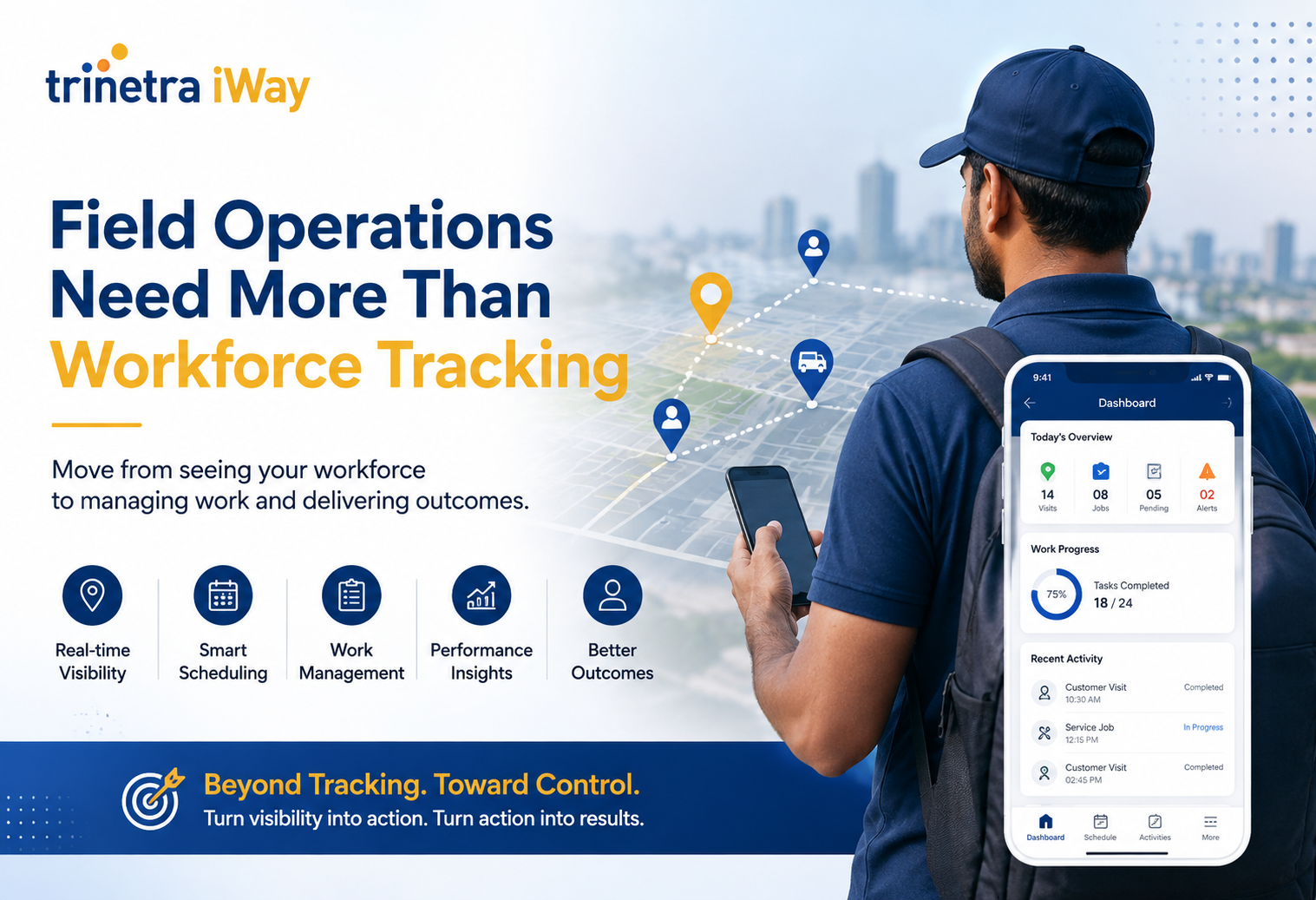
For organizations managing distributed sales and service workforces, real-time location has solved one longstanding management problem: knowing where field employees are. It has not solved the harder one—knowing whether the right work is being completed, whether customer commitments are at risk, and where management intervention will create the greatest value.
That distinction is becoming more important as field organizations replace spreadsheets, calls, messaging applications, and paper reports with mobile systems.
The next stage of field force management is not simply better tracking. It is the move from workforce visibility to field operations control.
For COOs and Operations Heads, that shift requires a different management question. Instead of asking, “Can we see the field workforce?” leaders need to ask, “Can we identify what is going wrong early enough to change the outcome?
About the Shift
GPS-enabled workforce visibility gave field operations teams information that was historically difficult to obtain.
A manager can establish whether an employee has reached a location. Attendance can be associated with field activity. Customer visits can be verified. Current location can provide useful context when an unplanned assignment needs to be made.
Those capabilities remain valuable, but they represent only the first layer of an effective field operating model.
A dot on a map cannot explain whether a sales representative visited the account that mattered most. It cannot establish whether a technician resolved a customer issue. It cannot tell a regional manager whether tomorrow’s workload exceeds available capacity. And it cannot determine whether a completed activity produced the intended commercial or service outcome.
This creates what can be called the field operations control gap: the distance between visibility into workforce activity and management’s ability to influence work execution.
Closing that gap requires three distinct forms of visibility.
Location visibility answers where a field employee is and, where appropriate, whether that person is available.
Work visibility explains what the employee is supposed to accomplish—appointments, customer visits, jobs, schedules, priorities, and assignments.
Outcome visibility establishes what resulted from that work—completion, unresolved action, customer feedback, a follow-up requirement, or another relevant business result.
Organizations create greater management value when these layers inform one another rather than operating as separate datasets.
Why This Matters
Many field operations become more difficult as they scale for a reason that has little to do with employee effort: coordination complexity increases.
A small team can often be managed using calls, personal knowledge, and manual schedules. Add more employees, territories, customer locations, service commitments, and last-minute changes, and managers begin spending a growing share of their time reconstructing what is happening.
Digitization can reduce that burden—but only when information is connected to management decisions.
McKinsey’s research on field-force performance has highlighted the weakness of relying on high-level activity measures alone. Metrics such as jobs per day or hours per job may show that performance has changed without explaining why. The same research found that field data frequently remains split across systems for dispatch, payroll, GPS, customer information, and other functions, leaving frontline managers to piece together the causes of operational problems manually.
That is the difference between data availability and operational intelligence.
A manager who knows that a technician is behind schedule has visibility.
A manager who knows why the schedule is slipping, which customer commitment is affected, whether another resource is available, and what intervention is required has operational control.
The management objective, therefore, should not be to collect the largest possible amount of field data.
It should be to shorten the distance between signal, decision, and action.
Key Highlights
- Location is context, not the outcome. GPS information becomes more valuable when interpreted alongside schedules, assignments, availability, customer visits, and job status.
- Activity should not be confused with productivity. Visits, kilometres travelled, working hours, and jobs attended can help explain performance, but they do not automatically establish business value.
- Exception management scales better than continuous monitoring. Managers need to know which deviation requires attention rather than watching every employee continuously.
- Workforce data should support a management decision. A useful operational metric should help a manager prioritize, allocate, intervene, coach, or redesign a process.
- Field operations maturity moves through stages: tracking people, managing work, managing exceptions, and ultimately improving outcomes.
Why Location Data Needs Work Context
Consider two service technicians.
Both arrive at their assigned customer sites at 10 a.m. If management sees only location, their performance appears identical.
Now add work context.
The first technician was scheduled for 9:45 a.m., completed a routine job within the expected period, and is available for another nearby assignment.
The second was scheduled for 9 a.m., arrived after an earlier job overran, is handling a high-priority customer issue, and has two subsequent appointments that may now be affected.
The same location event has a completely different operational meaning.
The relevant question is not whether both employees arrived. It is what management should do next.
This illustrates why field workforce technology increasingly has to be considered in terms of workflow context rather than tracking accuracy alone.
Trinetra iWay’s existing platform reflects several elements of this broader model. Its published capabilities include schedule management, field location and availability, attendance and leave management, dashboards and reports, customer feedback, order management, sales activity management, and mobile field-service execution. Its scheduling functionality describes allocation using factors including priority, proximity, and availability.
The important strategic point is not the presence of each individual capability.
It is that location information becomes more useful when placed within the context of who is available, what has been assigned, what is scheduled, what has happened, and what remains unresolved.
The Next Management Model Is Exception-Based
There is a practical limit to real-time monitoring.
Imagine an operations manager responsible for 150 distributed employees. A system could provide the current position of every individual, every minute of the day.
That would technically represent extraordinary visibility. It would also create a poor management interface.
The manager does not need 150 equally prominent status updates. The manager needs to know that three appointments are at risk, one high-priority job remains unallocated, one territory has an unusual concentration of incomplete visits, and a particular team’s workload is no longer balanced.
This is the shift from monitoring to exception management.
A mature field operating model defines what normal execution looks like and identifies when actual execution departs from that expectation.
The exceptions will vary by business.
For a service organization, the warning could be an unassigned priority ticket, a technician running materially behind schedule, repeat attendance at the same job, or an approaching service commitment.
For a field sales operation, the exception might be a priority account that has not been visited, a recurring follow-up that remains incomplete, weak coverage in a territory, or an imbalance in representative workloads.
For inspection or maintenance teams, the relevant deviation may relate to an overdue inspection, an incomplete workflow, or unavailable capacity.
Managers then concentrate their attention where intervention is valuable.
That is a fundamentally different philosophy from surveillance.
Field Productivity Needs an Outcome Layer
The same distinction should influence executive scorecards.
Field employee productivity is often measured through visible activities: attendance, number of visits, time on site, distance travelled, or number of jobs completed.
These are useful diagnostic measures. They become dangerous when treated as business outcomes.
A salesperson who records more visits is not necessarily producing better territory execution. A technician who closes more jobs may be working on a different job mix. An employee who travels further may be highly active—or may be operating within an inefficient territory design.
Leaders should therefore organize field metrics in a hierarchy.
At the base are activity measures: What happened?
Above them are execution measures: Did the work happen as planned?
At the highest level are outcome measures: Did the activity produce the result the organization wanted?
The purpose of an operational dashboard should be to help management move between those layers.
When an outcome deteriorates, leaders should be able to investigate the execution conditions behind it rather than immediately concluding that an individual employee is underperforming.
This is particularly important because productivity problems frequently originate upstream.
Poor allocation can look like weak employee productivity.
Insufficient capacity can look like poor responsiveness.
Unrealistic schedules can look like execution failure.
Fragmented customer information can look like weak field follow-up.
Measurement is most valuable when it reveals the operating cause rather than merely identifying the person closest to the symptom.
Industry Context: Distributed Operations Are Becoming Decision Systems
Field organizations across sales, service, installation, maintenance, telecom, utilities, manufacturing, and distribution are accumulating more operational data than previous generations of managers had available.
The strategic challenge is changing accordingly.
The issue is no longer simply obtaining field information. It is determining how that information should influence resource allocation and management decisions.
McKinsey’s field-force research argues for combining disparate data sources to create a more granular understanding of performance rather than forcing managers to navigate siloed systems. In a separate 2026 examination of distributed operations, McKinsey emphasized the importance of combining direction from the center with leadership closer to individual operating sites as distributed networks become harder to coordinate.
For field operations leaders, the implication is clear: visibility needs an operating model around it.
That includes defined responsibilities, clear escalation rules, appropriate access to information, and agreement about which conditions warrant intervention.
Technology can surface information. Management still has to decide what the organization will do with it.
Expert Perspective
The most useful way to think about field workforce technology is not as an increasingly sophisticated monitoring system.
It is as an operating layer connecting people, work, and management decisions.
For Trinetra iWay, that perspective is consistent with its broader positioning across field sales management, field service management, scheduling, field attendance, customer activity, and reporting rather than employee location alone. The company’s 2026 ideal-customer framework similarly identifies organizations moving away from spreadsheets, calls, messaging, and disconnected systems toward integrated field-force automation.
Executive quote placeholder — replace before publication:
“[Insert an original 50–80 word observation from the named Trinetra iWay executive explaining why field managers need work and outcome context—not simply more employee location data.]”
A useful executive principle is straightforward:
The quality of field visibility should be judged by the quality and speed of the decisions it enables.
If location information does not change an assignment, identify a risk, confirm execution, improve customer response, or help explain performance, its management value is limited
From Seeing Activity to Controlling Execution
The difference between tracking and field operations management can be stated simply.
A field employee tracking app helps establish where field employees are and provides location-related visibility.
A broader Field Force Management App or Field Staff Management Software connects that visibility with the operational context required to coordinate work—such as schedules, assignments, customer activities, availability, execution records, and management reporting.
The executive test is not how much information the organization can collect.
It is whether the organization can answer four questions quickly:
What should be happening?
What is actually happening?
Where is the meaningful deviation?
What should management do next?
Organizations that can answer those questions are moving beyond workforce observation.
They are building operational control.
And that is likely to define the next stage of digital maturity for distributed field teams.
About Trinetra IWay
Trinetra iWay provides field force management technology for organizations managing distributed sales and service teams. Its published solution areas include field sales management, field service management, scheduling, attendance and leave management, customer feedback, order management, location and availability visibility, dashboards, and reporting.
The company states on its website that it has more than 10 years in business, serves more than 100 clients across 15+ countries, and works across more than 20 industries.
Its strategic role in field operations is broader than employee GPS visibility: helping organizations connect workforce information with scheduling, sales and service execution, field activities, and management reporting.
FAQ
Expert Reviewed by Trinetra iWay
This article has been reviewed by Trinetra iWay’s internal product and technical team to ensure the information is accurate, practical, relevant, and useful for businesses managing field operations, workforce productivity, and digital transformation initiatives.
Review Scope:
Field force management, field service management, GPS tracking concepts, attendance management, scheduling workflows, customer visit tracking, reporting accuracy, workforce automation, and practical business applications for field-driven organizations.
Reviewed by:
Trinetra iWay Product & Technical Team
(Field Operations, Product, and Solution Experts)
Last Reviewed:
September 03, 2026


